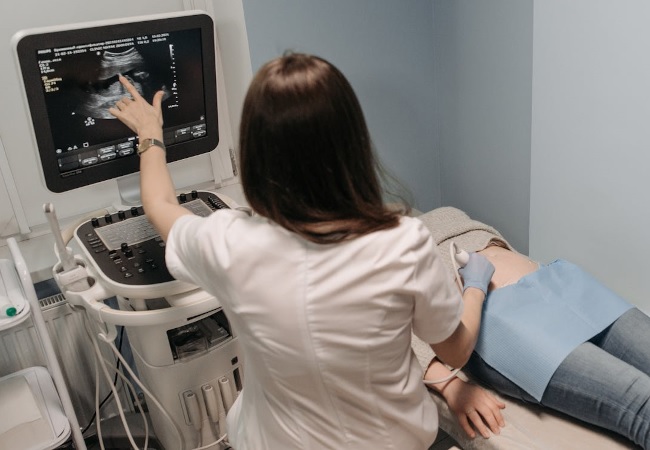

Finding out whether you're having a boy or a girl is a milestone moment in your pregnancy. But how exactly do our sonographers determine your baby's gender when all they've got to go on is a blurry black-and-white ultrasound image?
In this guide, we'll explain everything you need to know about ultrasound gender confirmation.
More...

Finding out the gender of your baby is an exciting moment, and in recent years, having a gender reveal party to announce the sex of your baby has become increasingly popular. If you’re expecting and are looking for unique and exciting ways to announce the sex of your baby, you’re in the right place!
More...
Back in February last year, a debate about choosing your baby’s gender was sparked by Chrissy Tiegen and John Legend revealing that they chose for their baby, Luna, to be born a girl. Understandably, this led many parents-to-be to question how this was possible and if they could do the same.
To answer the question: yes, choosing your baby’s gender is now possible due to the introduction of Preimplantation Genetic Screening (PGS) and Preimplantation Genetic Diagnosis (PGD). However, this only becomes an option to couples under certain circumstances. The gender selection procedure only becomes available to couples who want to avoid passing sex-linked genetic disorders onto their children, such as haemophilia in males and Rett syndrome in females.
That said, in rare cases, gender selection becomes available to parents who wish to ‘balance’ their family by having a child of each gender. Hormone tests are run to check the client’s fertility, and age limits may be applied. Some clinics will not consider clients unless they are married or already have at least one child of the opposite sex they’re trying for.
Methods of Gender Selection
The most accurate methods of choosing your baby’s gender can be very expensive and typically mean the mother-to-be has to undergo invasive infertility treatments, alongside taking fertility drugs with potential side effects.
In vitro fertilisation (IVF) is one of the main procedures which allows gender selection. IVF is a method of fertilisation outside of the womb, starting with a round of fertility drugs which help your ovaries create more than the natural amount of eggs (typically one per month). In an IVF procedure, the patient is placed under anaesthetic before the doctor inserts an ultra sound probe through the vagina to check the ovaries and follicles. A thin needle is then inserted through the vagina wall to remove the eggs from the follicles.
The next step is for the extracted eggs to be fertilised in a Petri dish. Once the eggs become embryos after 3-5 days, they are inserted back into the patient’s uterus. If you’re younger than 35 and your embryos are healthy, no more than two are usually transferred.
Preimplantation Genetic Diagnosis and Preimplantation Genetic Screening
The baby gender selection process happens during the IVF procedure, where one or two cells are removed from the embryo and tested for genetic or chromosomal disorders. Preimplantation Genetic Diagnosis (PGD) and Preimplantation Genetic Screening (PGS) can be used to screen the embryos and predict the baby’s gender. Parents who are hoping to avoid gender-linked disorders usually opt for PGD as the test exposes any underlying conditions the baby may have. By changing the gender of the baby, the prospective parents hope to avoid this disorder.
Preimplantation Genetic Screening is typically used by patients to check if their baby has down syndrome, or are hoping to ‘balance’ their family. Both tests are almost 100% accurate at determining the gender of the baby, and any remaining embryos are frozen so they can be used in the future if the couple decides to make more children.
The advancement of science truly is something to marvel at, but as these methods can be expensive and invasive, waiting to find out the gender of your child can be just as exciting. Wondering what your baby will be is one of the most magical parts of carrying a child and the long awaited day of the gender reveal is a milestone in the pregnancy. Here at First Encounters, we offer a gender scan from just 16 weeks, so you don’t have to wait too long either.
Expectant parents are often very keen to discover the gender of their unborn baby, and understandably so - knowing the gender is one of those things that really helps you to feel closer to your little bundle of joy. The people who come to our clinics for a gender scan frequently tell us that the baby seems a lot more 'real' to them once our sonographer has revealed whether it's a boy or a girl, and besides, finding out the sex is a nice little milestone to get excited for when the birth itself still seems a long way off.
With all of that in mind, it's easy to see why mums-to-be and dads-in-waiting might want to attend a gender scan as soon as possible. However, attend a gender ultrasound scan too early in your pregnancy and it may be impossible to accurately identify the gender - a foetus doesn't develop sexual characteristics until a few weeks in, and nothing conclusive will actually be visible on an ultrasound scan until a little while after that.
So, how soon can you find out the gender?
At First Encounters, we now offer a SneakPeek® gender test – ideal for parents who are too eager to wait until their gender confirmation ultrasound! The SneakPeek® test is a DNA-base, non-invasive prenatal blood test that can tell you whether you’re having a boy or a girl from as early as 6 weeks into your pregnancy.
How can SneakPeek® determine my baby’s sex?
When you’re pregnant, your bloodstream contains DNA from your unborn child as well as your own DNA. If your blood sample contains male (XY) chromosomes, this means you’re going to have a boy. If there are no male chromosomes present in the blood sample, it means you are pregnant with a girl.
This gender testing method is 99.9% accurate at 6 weeks gestation and you should have your results emailed directly to you within 7-10 working days.
How early can you have a gender scan?
Here at First Encounters Ultrasound we don't offer any gender confirmation ultrasound scans before 16 weeks gestation. Other scan providers may offer slightly earlier scans, but we would strongly recommend that you do not attend a baby gender scan until at least the 16-week mark. Any earlier, and your baby probably won't have developed sufficiently for accurate gender identification.
Is it worth waiting a little longer?
While we're happy to provide gender scans from 16 weeks onwards, it's worth bearing in mind that not all babies develop at the same speed. Very occasionally, someone will come in for gender confirmation at 16 weeks and the sonographer still won't be able to find positive visual confirmation of the baby's sex. In these cases, we'll usually offer a complimentary re-scan at a later date (we'll never guess the gender if we're not confident in our prediction!) but to avoid disappointment, you may wish to wait an extra few days just to make sure that your baby has developed to the point where we're able to identify the gender.
Countless parents have visited our clinics in the hope of discovering their unborn baby's gender - some do it so that they can decide on an appropriate name, while others ask to learn the gender in advance because they simply can't wait for the birth!
If you're thinking of getting a gender scan, you may well be wondering how accurate gender scans are, and how sure the sonographer will be when he or she reveals the gender of your unborn child.
How accurate are baby gender scans?
The answer is 'very accurate indeed', at least as far as we're concerned! Our sonographers are extremely well-trained and generally won't state the sex of the baby unless they're absolutely certain of your baby's gender.
To allow for an accurate gender confirmation, the baby's sex organs must be: a) reasonably fully-formed, and b) visible on the ultrasound scan. Our baby gender scans are available from 16 weeks onwards; we cannot confirm gender before this point for the simple reason that, generally speaking, genitalia are not visibly formed until around the 16-week mark!
Once you've reached 16 weeks gestation, our ability to predict your child's gender depends on their position inside the womb. Every so often, an expectant mother will come in for a gender scan only to find that her little one is resting in a position that makes it difficult for us to get an accurate idea of their sex. On these occasions, we ask the mother to take a brief stroll so as to get the foetus moving; we will then re-commence the gender scan, hopefully with more success.
What if we're unable to confirm your baby's gender?
It's a very rare occurrence, but if we can't tell what sex your baby is even after you've been for a walk, we will happily offer you a complimentary re-scan on a date that suits you. As previously mentioned, we will NEVER 'just guess' your baby's sex; if your gender scan proves inconclusive, you will be told as much by your sonographer. We have a reputation to uphold here at First Encounters Ultrasound, and so we will only ever tell you what we see on the scan - nothing more, nothing less.
Click the button below to book your gender scan today:
Any other questions? Get in touch with a member of the First Encounters Ultrasound team today!