are private ultrasounds safe

Recently, many worrying stories of unregulated ultrasound scan providers have come to our attention. There's a growing practice of misinformation and cutting corners that can cause customers to be sold a service that does not meet industry standards and, in the worst cases, can even cause mother and child to be put at risk. For this reason, we feel that it is vitally important for us to share this information with our readers, in order to allow expectant parents to make an informed decision when planning a private ultrasound scan.

While all 3D/4D ultrasound companies may seem quite similar at first glance, you may find on closer inspection that the provider you've chosen isn't being entirely honest about the services they offer. Here are some of the issues we've spotted most frequently here at First Encounters:


Misleading Customers Regarding Available Services

We've spotted many scan providers who claim to offer well-known services when in fact they do not use the equipment required to provide that service. One example of this is HD Live ultrasound, which can only truly be delivered using genuine HD Live equipment. We use an HD Live machine to conduct scans at our clinic in Cardiff, whereas at our Bristol clinic uses a GE Voluson I. Many providers will advertise that they offer 'HD Live' scanning, when in fact, they use other, inferior equipment to perform their scans.


Operating Without Regulation

In England, it has been mandatory for ultrasound providers to register with the CQC (Care Quality Commission) since 2010, yet some providers still attempt to avoid this requirement by claiming that their scans are 'for entertainment purposes only'. Those operating without regulation will often employ staff who have not been trained to a professional standard, and will use equipment that has not been properly tested - all without being subject to any independent inspections. To comply with English law and provide the highest level of service possible, First Encounters Bristol is approved, registered and regulated by the CQC, and is subject to regular checks to validate the quality of our services.

While our Cardiff clinic is unable to register with the CQC due to being based in Wales, not England, we do ensure that it meets the same standards as the Bristol clinic at all times. Many similar providers in Wales neglect to do so, due to the fact that the HIW (Health Inspectorate Wales) does not currently regulate the same diagnostic and screening activities as those monitored by the CQC in England. This is something to keep in mind when booking in Wales, as this makes it easier for unscrupulous scan providers to operate without detection.


Potentially Unsafe Equipment

As we've already touched upon, we strive to use the most up-to-date ultrasound equipment at our facilities. All of our equipment is purchased directly from the manufacturer, who gives us the knowledge required to set up and use these products properly. We also ensure that this equipment is inspected and serviced on a regular basis, in order to confirm that it is safe for use at all times.

Many scan providers do not meet the same standard, sourcing equipment second-hand and setting it up without the proper knowledge. One particular risk comes from providers who do not properly isolate the equipment they are using - this is very dangerous as it can lead to electric shocks!


Unqualified Sonographers 

Alongside their use of unmonitored and unreliable equipment, many independent scan providers will employ staff who are not properly qualified to perform a baby scan. In some cases, this will mean using sonographers who do not have any previous experience performing baby scans, rendering them unaware of what exactly to look for during a scan. In the worst cases, companies may use individuals who are not qualified whatsoever, a practice we view as highly irresponsible.

At both First Encounters clinics, scans are performed by qualified obstetric sonographers, which means that they have both the knowledge needed to operate ultrasound equipment and the experience needed to perform a baby scan and diagnose potential problems. Each of our sonographers is also registered with the Health and Care Professions Council (HCPC), which regulates their practice and ensures that they have the right skills and training to do their jobs.


So, Are Private Ultrasounds Safe?

In general, private ultrasounds are equally as safe as an NHS service; however, if you are concerned about a company's credentials as a responsible scan provider, here are a few things you can look out for:

  • Are they registered with the correct regulatory bodies? Is there evidence of this on their website?
  • Do they mention that their practice is for 'entertainment only' or 'non-diagnostic'? These could be warning signals that the practice is unregulated.
  • Does their equipment/staff register measure up with the services advertised?
  • Are their prices significantly lower than those other practices? If a price or deal seems too good to be true, it probably is!

More Info About First Encounters >

If you've had a look at our Images & Videos section, you may be wondering if the examples on that page really are representative of the quality and the clarity you'll see on the screen when you come in for a 4D scan of your own. Will we be able to depict your unborn baby with that same level of detail?

3D Baby Scan

The short answer is yes, for the vast majority of scans we perform. However, 4D ultrasound scans are not an exact science, and with each and every pregnancy being so very different, the achievable results can vary for each client, thus making it very difficult to provide an airtight guarantee when it comes to the quality of the imagery we aim to capture during our 3D/4D scans. That said, we will always endeavour to obtain the very best result achievable, working with you to encourage your baby into the best possible position; however, whilst a change of position can, in most cases, be achieved with the aid of sugar stimulation, there are other factors that may affect image quality and resolution.

All ultrasound scans obtain images via the reflection of sound waves, which penetrate from the probe placed on your belly through to your baby and back again. The image then displayed is the result of this reflection. Whilst we at First Encounters Ultrasound use the latest, most advanced ultrasound technology (effectively enabling an element of image manipulation), image quality and resolution can unfortunately be impaired if the sound waves have more distance to travel, thus creating a weaker reflection and a lower-resolution image.

In some cases, a high BMI can lead to a less than perfect result; however, our own experience has also identified that, in cases of a high BMI, clearer images can be achieved when the scan is performed slightly later (between 29 and 30 weeks gestation). This is because the baby sometimes moves closer to the stomach wall, thus creating a shorter distance for the reflected sound waves to cover, resulting in a better image resolution.

The key points to remember when planning your 4D experience are as follows:
  • Your baby will require room for movement.
  • Your baby will need to be surrounded by plenty of fluid to assist the projection of imagery
In order to achieve the best possible results, we always recommend between 25 and 29 weeks as the optimum time for a 3D/4D scan. However, in the event that your baby is uncooperative on the day, a complimentary rescan will be offered on an alternative day (where appropriate, and subject to terms and conditions).

All of this being said, we'd like to say once again that unsatisfactory scans are very few and far between. The vast majority of women who come to us leave absolutely thrilled with the results of their 4D scan - if you'd like to book a scan of your own, please click here to compare the packages we offer. Alternatively, if you have any other questions to ask, feel free to give us a call on 02920 732671.
 
If you're expecting more than one baby, you may be wondering if you can still come to the First Encounters clinic for a 3D/4D bonding experience. In other words...

Can I have a 4D scan if I'm pregnant with twins?

Yes, you can! Many of the expectant mothers we meet are carrying more than one baby, and we frequently carry out scans (both 2D and 3D/4D) on unborn twins. After all, why should you be denied the breathtaking experience of glimpsing their world just because it's a little crowded in there?
 
However, there are a couple of things to bear in mind as you're booking your appointment with us. We recommend that twin scans are carried out between 22 and 26 weeks gestation; any later, and the footage we capture may not be of a satisfactory quality. You see, 4D ultrasound scans tend to give better results if the babies still have a little room in which to move around, and since two babies take up more space than one, we like to get the scan done a little earlier in cases of multiple pregnancies.
 
There's also the issue of payment. Twin scans take longer to perform than individual scans, and this will be reflected in the cost of your scan package. For all of our scans, there is a surcharge if you are carrying twins. This is because we effectively have to perform the scan twice, recording the position, measurements, and heartbeat of two babies instead of just one.
 

The following scan packages are available for multiple pregnancies:

  • EarlyReassure™ (7-13weeks) - a scan tailored to the early stages of pregnancy. We can date the pregnancy, visualise a heartbeat and identify if you're having twins! (Multiple Pregnancy Surcharge £20).

  • Growth&Wellbeing™ (16-34 weeks) - a scan that's designed to obtain growth measurements and check the wellbeing of your baby (or babies)! (Multiple Pregnancy Surcharge £20).

  • GenderGrowth&Wellbeing™ (16-32 weeks) - a scan designed to obtain growth measurements and perform wellbeing observational checks on your baby after your initial NHS dating scan (Multiple Pregnancy Surcharge £25).

  • 4DGrowth&Wellbeing™ (24-32 weeks) - a scan primarily designed to obtain growth measurements and perform wellbeing observational checks on baby after your NHS anomaly scan between 24-32 weeks gestation (Multiple Pregnancy Surcharge £40).
 
We regret that we are not able to accommodate triplets (or quadruplets, quintuplets, etc.) in any of our scan packages.
 
Ready to meet your twins? Book your First Encounters Ultrasound scan now!
 
4D scans
 
We get asked a lot of questions here at First Encounters Ultrasound, but perhaps the most common query of all concerns the safety of the scans that we provide. Many expectant parents feel slightly apprehensive about the idea of undergoing an ultrasound scan for fear that it will have a detrimental effect on the mother and/or her unborn baby.
 
The good news is that, in 30 years of study and research, ultrasound has not been found to cause any harm whatsoever to mother or baby. As the name suggests, ultrasound technology relies on sound waves, which are perfectly safe at the intensity used for the purposes of pregnancy scanning.
 
Ultrasound scans are now the norm throughout the UK; even if you don't visit the First Encounters clinic for a private scan, you will likely undergo two NHS ultrasound scans over the course of your pregnancy to check on your baby's development.
 

But what about 4D scans?

Most of the parents who enquire about the safety of our scans are referring specifically to our 4D scan packages; that is, the scans that capture 3D footage like this:
 
 
A lot of people assume that 4D scans must use a higher intensity than standard 2D scans, if not a different type of technology altogether. Many of the parents-to-be that we encounter have already received one ultrasound scan by the time we speak to them, and even some of these people are concerned about the side effects of our 4D scanning equipment.
 
If you are harbouring any such concerns yourself, allow us to put your mind at ease: 4D ultrasound scans have been shown to be completely safe for both mother and baby. Our 4D probe operates at the same intensity as our 2D scanning equipment, emitting sound waves into the body and creating an image based on the echoes it hears. The technology actually has a lot in common with radar!
 
Ultrasound scans do not expose you or your baby to radiation and they are generally painless. The only side effects you may experience is a small amount of discomfort as we run the probe over your skin or insert it into your body. 
 
None of the ultrasound scans we offer have been shown to have any harmful effect on human beings, so when you and your unborn child pay us a visit, you can rest assured that our service is not putting either of you in any danger whatsoever.
2D scan vs. 4D scan
 
Many people aren't quite sure of the difference between a 2D scan and a 3D/4D scan. We offer both options here at First Encounters - today, we're going to explain each option in detail, helping you to select the ultrasound scan package that suits you best.

4D Scans

A 4D ultrasound scan - such as our 4DGrowth&Wellbeing™ package - allows you to see what your baby really looks like via detailed three-dimensional footage. Some clinics offer '3D scans', which give still images of your baby; here at First Encounters, we specialise in 4D ultrasound, which allows you to see your baby moving around in real time. 3D scans produce photographs; 4D scans produce video footage.
 

Here are some further details about our 4D scans:

  • 3D/4D ultrasound technology renders an image from the surface of your baby's skin for unparalleled detail

  • Scan footage is projected onto a large plasma television screen, allowing you and your guests to watch

  • Our 4D scans are popular among expectant mothers who have already received their dating and anomaly scans, and who now wish to take a closer look at the baby that's growing inside them. Our 4D scans make fantastic baby bonding experiences, giving you a detailed glimpse into your baby's world and bringing you a little bit closer to the child you're about to bring into the world.

  • Some of our 4D scan packages (e.g. 4DGrowth&Wellbeing™) include complimentary baby sexing; others allow you to find out the sex upon request. However, gender confirmation is always done via a 2D ultrasound scan, even if your package includes 3D/4D imaging.

  • After your 4D scan, you will have the opportunity to purchase a variety of lovely souvenirs that can be shared with friends and relatives. These range from printed photographs and DVDs to key rings, fridge magnets, and our adorable Heartbeat Teddies (featuring your unborn baby's heartbeat!)
 

2D Scans

2D ultrasound scans don't offer the same level of detail as our 4D packages - you won't really be able to see your baby's face, for example - but they still allow our sonographers to get all the important information about your child. Options like our Growth&Wellbeing™ package are designed to reassure you about your baby's growth and wellbeing; other 2D scan packages can even tell you whether your unborn baby is a boy or a girl!
 

Here's a little more information on our 2D baby scans:

  • A 2D ultrasound scan produces a black-and-white image that show's your baby's skeletal make-up and allows the sonographer to identify any potential anomalies. As previously mentioned, this two-dimensional view is also ideal for gender confirmation, but please check if this is available with your chosen scan.

  • While a 2D scan doesn't afford the same level of detail and bonding as a full 4D package, you and your guests will still be able to watch the scan on our plasma screen TV and purchase a variety of cute souvenirs after the appointment.
 
Still not sure which scan is right for you?
 
Compare Our Ultrasound Packages >                                  Get In Touch For More Info >
 

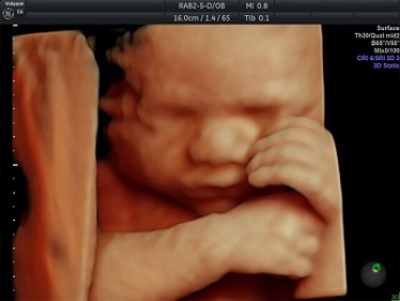
The best time for a 4D ultrasound scan is around 27 weeks into your pregnancy. While 4D scans are available from 24 to 32 weeks, we recommend having the scan at 26 – 29 weeks in case your baby is growing slower or faster than average.
4d baby scan

Expectant parents often ask us how long they should wait before coming in for a 4D ultrasound scan. Obviously, if the scan is carried out too early, the foetus will not have developed far enough to give a satisfactory image, but waiting until the final weeks of your pregnancy isn't a very good idea either.

Many people believe that they must wait until at least 30 weeks to book an ultrasound session, but this—if you'll pardon the pun—is a misconception. Here at First Encounters Ultrasound, we offer a 4D scan from 24 weeks to 32 weeks; however, we recommend 26 – 29 weeks as the optimum time for a 4D scan, as this allows us to accommodate babies who are developing at a slower or faster rate than average. It would be a shame if you visited our clinic at the start of your 24th week, only to find that your baby isn't quite ready for the camera yet!

So, to answer your question: the best time to have a 4D baby scan is around 27 weeks. However, this does not mean that a satisfactory image cannot be captured later on; every pregnancy is different, of course, but we are almost always able to achieve great results up to 32 weeks.

Upon request, we can also determine the gender of your baby during your 4D scan to make the experience all the more memorable.


Why can't I have a 4D scan after 32 weeks?

As mentioned above, the cut-off point for our 4D scan is 32 weeks. You may be wondering why this is the case; surely the image would be even better if we waited until the baby was completely developed?

The reason is quite simple: there's only a limited amount of space in your womb, and our sonographers are able to achieve better results when there's still some room left in there.

The main aim of a 4D scan is to capture an image of your baby's face, and we can only do that if he or she is facing the camera (or rather the ultrasound probe) when the scan takes place. If, when you arrive at our clinic, your baby is facing your back, he/she will need room to turn around—otherwise, we're stuck looking at the back of baby's head!

As your child grows, they leave less and less room for moving around, which means that the chances of turning become quite slim after the 32-week point. Furthermore, fluid levels reduce as the pregnancy develops, which will further impede the projection of imagery and also your baby's movement within the womb.


Is there any way to encourage movement?

Want to keep your baby moving on the day of your scan? Here are a few suggestions:

  • Sugar stimulation is a good way to promote movement in utero. Eating a bar of chocolate and/or having a fizzy drink about 20 minutes before your scan will give your baby a burst of hyperactivity!

  • We recommend having a full bladder when you come in for your 4D scan. If your baby's head is pointed downwards, he or she may decide to play hide-and-seek by burying it in your pelvic area. An inflated bladder helps to prevent this from happening, lifting your baby into a better position for the camera.

  • If you come in for your scan and your baby is feeling camera-shy, we will recommend that you take a brief walk to get things moving in there.

If all else fails and we are unable to get a good picture of your unborn child, we will be more than happy to offer you a complementary re-scan visit on another date.

Click below to browse our scan packages and book your 4D ultrasound appointment online!

Browse Our Scan Packages >