Archive

During the first few days of pregnancy, a fertilised embryo attaches to the uterine lining and your body begins to release a hormone called human chorionic gonadotrophin (HCG).

Pregnancy tests determine whether you are pregnant or not by trying to detect this hormone in either your blood or your urine. Urine tests can be carried out at home while blood tests are carried out by your local GP.

Positive Result

If you have just done a home pregnancy test and find that your test is showing a positive result, it is almost certain that you are pregnant. The test has positively detected the pregnancy hormone HCG in your urine.

Negative Result

A negative result can be slightly more ambiguous. It either means; you are not pregnant, you took the test too early so not enough hormone was present in your urine yet, or you took the test incorrectly. Be aware that some home pregnancy tests are more sensitive to detecting HCG than others.

What Should I do if I Take Multiple Tests and get Different Results?

In this circumstance, we recommended that you visit your GP and have a blood test done to get an accurate answer, however you will have to wait slightly longer to receive the results from this test.

If you find out that you are pregnant, why not book a First Encounter’s EarlyReassure™ scan? Available as soon as 7 weeks after conception, this is a scan you can attend before your first NHS scan to seek reassurance about numerous aspects of the pregnancy.

Can You Choose Your Baby's Gender?

Back in February last year, a debate about choosing your baby's gender was sparked by Chrissy Tiegen and John Legend revealing that they chose for their baby, Luna, to be born a girl. Understandably, this led many parents-to-be to question how this was possible and if they could do the same.

To answer the question: yes, choosing your baby’s gender is now possible due to the introduction of Preimplantation Genetic Screening (PGS) and Preimplantation Genetic Diagnosis (PGD). However, this only becomes an option to couples under certain circumstances. The gender selection procedure only becomes available to couples who want to avoid passing sex-linked genetic disorders onto their children, such as haemophilia in males and Rett syndrome in females.

That said, in rare cases, gender selection becomes available to parents who wish to 'balance' their family by having a child of each gender. Hormone tests are run to check the client's fertility, and age limit may be applied. Some clinics will not consider clients unless they are married or already have at least one child of the opposite sex they're trying for.


Methods of Gender Selection

The most accurate methods of choosing your baby's gender can be very expensive and typically mean the mother-to-be has to undergo invasive infertility treatments, alongside taking fertility drugs with potential side effects.

In vitro fertilisation (IVF) is one of the main procedures which allows gender selection. IVF is a method of fertilisation outside of the womb, starting with a round of fertility drugs which help your ovaries create more than the natural amount of eggs (typically one per month). In an IVF procedure, the patient is placed under anaesthetic before the doctor inserts an ultra sound probe through the vagina to check the ovaries and follicles. A thin needle is then inserted through the vagina wall to remove the eggs from the follicles.

The next step is for the extracted eggs to be fertilised in a Petri dish. Once the eggs become embryos (after 3 to 5 days) they are inserted back into the patient's uterus. If you're younger than 35 and your embryos are healthy, no more than two are usually transferred.


Preimplantation Genetic Diagnosis & Preimplantation Genetic Screening

The baby gender selection process happens during the IVF procedure, where one or two cells are removed from the embryo and tested for genetic or chromosomal disorders. Preimplantation Genetic Diagnosis (PGD) and Preimplantation Genetic Screening (PGS) can be used to screen the embryos and predict the baby's gender. Parents who are hoping to avoid gender-linked disorders usually opt for PGD as the test exposes any underlying conditions the baby may have. By changing the gender of the baby, the prospective parents hope to avoid this disorder.

Preimplantation Genetic Screening is typically used by patients to check if their baby has Down's syndrome, or are hoping to 'balance' their family. Both tests are almost 100% accurate at determining the gender of the baby, and any remaining embryos are frozen so they can be used in the future if the couple decide to have more children.

The advancement of science truly is something to marvel at, but as these methods can be expensive and invasive, waiting to find out the gender of your child can be just as exciting. Wondering what your baby will be is one of the most magical parts of carrying a child, and the long-awaited day of the gender reveal is a big milestone in the pregnancy. And you don't have to wait too long! Here at First Encounters, we offer gender scans from 16 weeks and DNA gender testing from just 6 weeks.

Book Gender Scan   Book Early Gender Test

Heartburn During Pregnancy


Why Have I Got Heartburn During Pregnancy?


As your baby develops you may find that it is more than just your desire to meet them that’s burning. Heartburn during pregnancy is a frequent occurrence and can be recognised by a burning sensation that resides all the way from your breastbone to your lower throat. Many mothers experience heartburn for the first time during pregnancy and although it is quite uncomfortable, it is usually harmless. The reason heartburn occurs so frequently during pregnancy is due to the placenta producing the hormone progesterone. 

 
Progesterone is usually your friend throughout pregnancy, helping to prevent miscarriages through thickening the uterine lining, and promoting your natural health by reminding you to provide nutrients for your baby. However, this does not mean that progesterone won’t cause you pain from time to time. 
 
As it relaxes the muscles of the uterus and the valve that separates the oesophagus from the stomach, it also allows gastric acids to flow back up to the oesophagus, causing the nasty burning sensation. Your wiggling baby also contributes to your heartburn by placing pressure on the stomach and increasing the chance of acids being pushed into the oesophagus.

What Can I Do to Stop My Heartburn? 


1. Find out what triggers it

 
The first thing you can do is make a note each time you have heartburn of what you’ve previously had to eat or drink. Certain foods tend to directly impact heartburn during pregnancy, such as acidic foods, greasy foods, spicy foods, caffeine, fizzy drinks and chocolate. If you can figure out what is causing your heartburn, you can try to eliminate it from your diet and relieve the pain. 
 

2. Try to avoid big meals

 
Big meals increase the chance of heartburn, as food does not digest as well or move as quickly during pregnancy. It is better to eat several small meals throughout the day, taking your time to eat and chewing thoroughly. 
 

3. Take care when you sleep

 
Keeping your upper body elevated while you sleep can help stop your stomach acids from reaching the oesophagus. Try to also avoid eating anything 3 hours before bedtime, as this decreases the chance of the stomach acids reaching you even further. 
 

4. Try chewing gum

 
After eating, chewing gum helps eliminate heartburn during pregnancy. This is due to the chewing motion producing saliva which can help neutralise the acid. 
 

5. Over-the-counter help

 
If all else fails, any over-the-counter antacid which contains magnesium or calcium may help relieve you of the pain. However, you should first check with your prenatal nurse before taking anything to ensure that it is safe for you during pregnancy. 


If your heartburn during pregnancy continues to persist after these methods, be sure to contact your health care provider to see if there are any prescription medicines you can take to help you. Be sure to contact them immediately if you spit up blood or have dark-coloured bowel movements as this is a sign of blood in your digestive tract. We hope these tips help you relieve some of the pain and enjoy every moment of your pregnancy!
 
For more pregnancy news and advice, follow us on Twitter or Facebook.
 
We all love a bargain, and if you're interested in booking a 4D baby scan and getting a breathtaking glimpse of your unborn baby's face, you may be tempted to visit a deals / vouchers website like Groupon or Wowcher to see what discounts are currently available online. Groupon in particular seems to be perpetually flooded with dirt-cheap 4D ultrasound packages, with providers sometimes cutting their prices by 50% or even more in the hope of filling up more scan slots.
 
However, before you book a discounted 4D scan through a Groupon or Wowcher deal, here are some things you should take into consideration:
 

Many of the scan providers on Groupon are fairly new companies.

Offering a heavily-discounted scan package through a website like Groupon is a popular way for new scan providers with no established market presence to 'get the word out', as it were. An eye-catching offer can be a good way to get people talking about your company, and the hope is that customers who get the cut-price package will come back later for a full-price scan and/or recommend the clinic to their friends and family members in future.
 
The problem for customers, however, is that brand new companies have no track record by which to judge them. Established scan providers tend to have lots of reviews online, but when you go to a recently-opened ultrasound clinic that's using Groupon and Wowcher to drive that initial burst of bookings, you may not have any way of knowing whether they are able to provide a safe, satisfactory scanning experience using the right methods and equipment. This could mean that the sonographer is unable to capture good-quality footage of your baby, and in the worst cases, it could even put you / your baby in danger (e.g. from electric shocks).


Scan time may be very limited, and you may not be offered a re-scan.

We've found that many providers who sell their scan packages for reduced prices compensate for this by packing as many scan slots into the day as possible. This means that each customer's scan period must be rigidly adhered to and that's not always conducive to a satisfactory scan experience. For example, if the company has allotted 10 minutes for your 4D scan and the sonographer finds upon commencing the scan that your baby is facing the wrong way, you may not have time to go for a walk and try again because this would cause you to overrun your 10-minute window and cut into the next customer's appointment.
 
When this happens, most companies would offer a re-scan on a different date, but the fine print on Groupon offers often includes a stipulation like this:
 
"If satisfactory imagery cannot be obtained, no re-scan will be offered."
 
This means that you would have to pay full price for another appointment if your first, discounted appointment did not yield satisfactory scan footage / photos.


Why choose First Encounters?

Here at First Encounters Ultrasound, we never run offers through websites like Groupon or Wowcher - all of our scan packages are priced as seen here. However, we believe that we provide an experience that's far superior to any you'll get through those websites. Here are just a few of the reasons why:
  • All of our scans are performed by qualified, experienced medical professionals.

  • We only use certified safe equipment from GE Healthcare.

  • Our appointment slots always include time for multiple scan attempts.

  • We always offer a complimentary re-scan if satisfactory imagery cannot be obtained on your first scan date.

  • Our reputation is second to none - just look at the reviews on our Facebook page!


Book a 4D Scan Contact Us

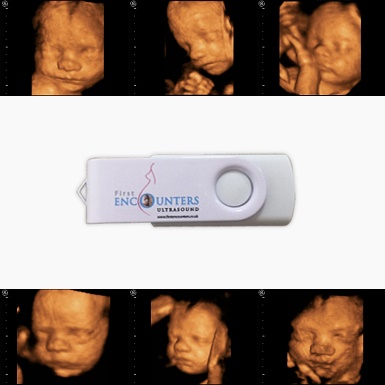
Ultrasound Scan Video on USB Stick
From key rings, to magnets, to our ever-popular Heartbeat Bear, we offer a great variety of baby scan souvenirs here at First Encounters - if you want to take home a memento of your ultrasound experience, there are plenty of options to choose from.
 
That said, the best souvenir of all is often the footage that we capture during the scan itself. Previously, the only way for our customers to take home their scan footage was on a DVD, but we now provide footage on a disc in the more versatile MP4 format. Furthermore, for an extra £10 you can upgrade to an even more convenient option: your ultrasound scan video on a USB stick!
 

Whether you visit us for a 2D scan or a 3D/4D scan, we can save your scan footage onto a handy little First Encounters USB stick for you to take home and use as you please. You will also receive the MP4 file on a disc as standard.
 
Unlike a DVD recording, the MP4 format allows you to accomplish the following with ease:
  • Save your scan video to your own computer
  • Create a backup version of your scan video
  • Share the footage with friends and family online
  • Burn multiple copies to disc as gifts for your loved ones

In addition to the video file, your First Encounters USB stick can also be loaded with all of the photographic images captured during your ultrasound scan (we usually capture at least 20-25 photos per scan). This means you'll have easy access to an extensive collection of pictures to post on Facebook and send to your relatives, no matter where in the world they are.

 
Ready to book your baby scan and create the memories you'll cherish for a lifetime? Click here to see our scan options, or visit our Cardiff Clinic Location Page to find our First Encounters Ultrasound clinic.
Male and female gender symbols

Expectant parents are often very keen to discover the gender of their unborn baby, and understandably so – knowing the gender is one of those things that really helps you to feel closer to your little bundle of joy. The people who come to our clinics for a gender scan frequently tell us that the baby seems a lot more 'real' to them once our sonographer has revealed whether it's a boy or a girl, and besides, finding out the sex is a nice little milestone to get excited for when the birth itself still seems a long way off.

With all of that in mind, it's easy to see why mums-to-be and dads-in-waiting might want to book a gender scan as soon as possible. However, if you attend a gender ultrasound scan too early in your pregnancy, it may be impossible to accurately identify your child's gender – a foetus doesn't develop sexual characteristics until a few weeks in, and nothing conclusive will actually be visible on an ultrasound scan until a little while after that.


So how soon can I find out the gender?

Here at First Encounters, we offer an early gender blood test that's ideal for parents who are too eager to wait until their gender confirmation ultrasound. This is a DNA-based, non-invasive prenatal blood test that can tell you whether you're having a boy or a girl from as early as 6 weeks into your pregnancy.

Book a Gender Blood Test


How can a blood test reveal my unborn baby's sex?

When you're pregnant, your bloodstream contains DNA from the child in your womb. If your blood sample contains male (XY) chromosomes, this means you're going to have a boy. If there are no male chromosomes present in the blood sample, it means you are pregnant with a girl.

This gender testing method is 99.9% accurate at 6 weeks gestation and you should have your results emailed directly to you within just a few days of having your blood taken at our clinic.

Learn more about early gender testing >>


How early can I have a gender scan?

It depends on your ultrasound provider. Here at First Encounters Ultrasound, we don't offer any gender confirmation ultrasound scans until the 16-week mark. Other scan providers may offer slightly earlier scans, but we would strongly recommend that you do not attend a baby gender scan until you're at least 16 weeks along. Any earlier, and your baby probably won't have developed sufficiently for accurate gender identification.

FURTHER READING: Why Can't I Have a Gender Scan Before 16 Weeks?


Is it worth waiting a little longer?

While we're happy to provide gender scans from 16 weeks onwards, it's worth bearing in mind that not all babies develop at the same speed. Very occasionally, someone will come in for gender confirmation at 16 weeks and the sonographer still won't be able to find positive visual confirmation of the baby's sex. In these cases, we'll usually offer a complimentary re-scan at a later date (we'll never guess the gender if we're not confident in our prediction!) but to avoid disappointment, you may wish to wait an extra few days just to make sure that your baby has developed to the point where we're able to identify the gender.

Book a Gender Scan   Contact Us Today

 
You may have heard - or read - about the 'Doppler' heart monitors that are currently very popular among expectant parents. Dopplers are small handheld devices that use ultrasound technology to monitor your unborn baby's heartbeat, ostensibly giving you an easy way to hear your child's heartbeat in the comfort of your own home.
 
It's easy to imagine why these devices have become so popular. They are relatively cheap to purchase, and when they work, they enable you to hear the heartbeat (a very moving experience for many parents-in-waiting) without having to visit a hospital or a private ultrasound clinic.
 
But there's one problem with Dopplers that we've come across time and again: they sometimes fail to find a heartbeat. Unborn babies tend to move around and change position a lot (especially prior to 30 weeks gestation), and this means that it is often very difficult to find the right spot. And even if you do find the right spot, there's still no guarantee that you'll hear anything - our highly-trained sonographers occasionally struggle to pick up an audible heartbeat, and that's with a visual representation of the baby on-screen.
 
When a Doppler fails to deliver an audible heartbeat, it can understandably be a source of panic for the mother. In the majority of cases, the foetus turns out to be absolutely fine, but getting stressed and rushing to the hospital is neither healthy nor a particularly enjoyable experience when you're pregnant!
 
This isn't to say that Doppler monitors should necessarily be avoided. They have provided many heartwarming moments for expectant parents, and in some cases, they can be a great source of reassurance. However, they can also have the opposite effect, breeding panic when in reality the unborn baby is perfectly healthy. Please bear this in mind before using a Doppler, and remember that these handheld home devices are no substitute for a full ultrasound scan carried out by a registered health professional.
 
We have seen a few scan providers who do offer home visits, but these really are best avoided, for the following reasons:
 
  • Portable scanning equipment is generally inferior to the state-of-the-art machinery found in the best ultrasound clinics

  • Plugging equipment into an unprotected power source may result in electric shock to the mother / baby

  • As explained here, regulated scan providers in England are not allowed to perform home scans as regulation only extends to a clinic environment


As much as we'd like to offer our clients the full First Encounters experience in the comfort of their own homes, there are simply too many obstacles - we wouldn't be able to deliver the professional, high-quality service that's available in our clinics.
 
Visit our Scan Packages page to browse the baby scan packages we offer.
 
First Encounters Safe Scan
Here at First Encounters Ultrasound, we are dedicated to the safety and wellbeing of everyone who visits our clinics. No matter which of our scan packages you select, we want you to feel completely confident and reassured when you choose us as your scan provider.
 
As you browse our website, you will likely see our 'Safe Scan' badge on a number of different pages. This is our own personal seal of quality, and it represents our commitment to keeping you safe from potential hazards and health risks when you undergo a First Encounters baby scan.
 
We accomplish this in two ways: by employing experienced, qualified sonographers and by using certified state-of-the-art scanning equipment from the world's leading supplier.
 

Our Sonographers

Our sonographers - the members of staff responsible for carrying out each scan - are all qualified health professionals who are capable of identifying diagnostic issues as well as capturing high-quality souvenir imagery. Every First Encounters sonographer is registered with either the Health and Care Professions Council (HCPC) or the Nursing and Midwifery Council (NMC), which means that they meet these regulators' exacting standards in a range of important areas such as hygiene and professional behaviour.
 
All of our sonographers are fully qualified, fully trained, and highly experienced. They all hold postgraduate diplomas and know exactly how to conduct a safe scan that gets the best possible results for the expectant mother while keeping her and her unborn child completely protected throughout. 
 

Our Equipment

The equipment we use to carry out our scans is all supplied by GE Healthcare, the world's leading manufacturer of ultrasound/baby scanning equipment. Our 2D, 3D and 4D scans are performed using the GE Voluson E6, with HDlive technology that's capable of capturing clearer, crisper images than ever before.
 
More importantly, though, all of our machines are rigorously tested and certified safe for use, so rest assured that your safety will be preserved no matter what type of scan you opt for.
 
*
 
There are countless ultrasound clinics operating in the UK today, but many of them don't go anywhere near far enough in the safety measures they take. An alarming number of scan providers don't employ registered health professionals or use certified scanning equipment, and this approach can unfortunately lead to dire consequences.
 
Here at First Encounters, we do everything we possibly can to ensure the safety of you and your unborn child. Click here to browse our available scan packages, or feel free to contact us now if you have any further questions.