Author: warren

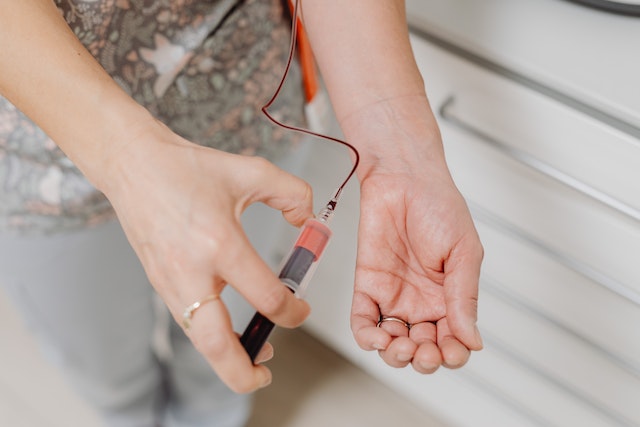
non-invasive prenatal testing

The best time for NIPT (Non-Invasive Prenatal Testing) is 10 weeks into your pregnancy. If you are planning to have a NIPT test, it's best do it as soon as possible after you've passed the 10-week mark.

NIPT (Non-Invasive Prenatal Testing) is a screening test that aims to determine whether an unborn baby has chromosomal abnormalities that are likely to result in genetic conditions like Down's syndrome, Edwards' syndrome or Patau's syndrome.
Baby scan

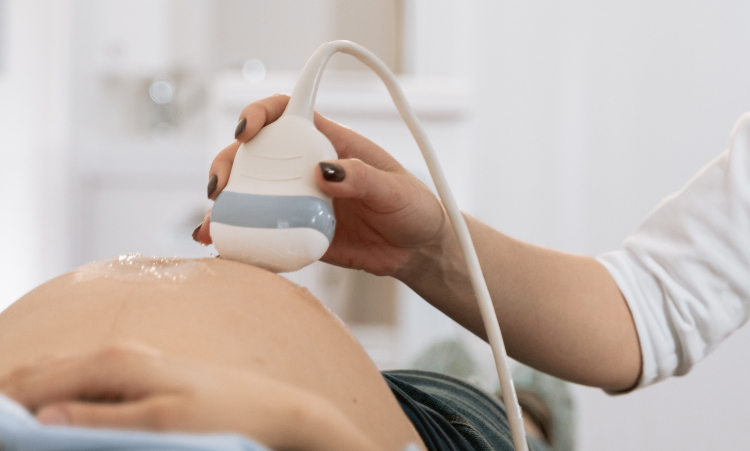
If you're pregnant and you're looking for great deals on private baby scans, we at First Encounters Ultrasound have several offers that may appeal to you. All of these pregnancy scans are performed by qualified sonographers at our warm and welcoming ultrasound clinic in Cardiff.

Our current baby scan offers are listed below—we often update this page with new deals and discounts, so be sure to check back regularly!

Wine glasses for drinking during pregnancy
 
Can you drink while pregnant? Drinking during pregnancy is a something of a grey area when it comes to prenatal health.
 
There is no well-defined limit for expectant mothers to follow, and so it can be difficult to establish how much alcohol - if any - is safe to consume while pregnant.
 
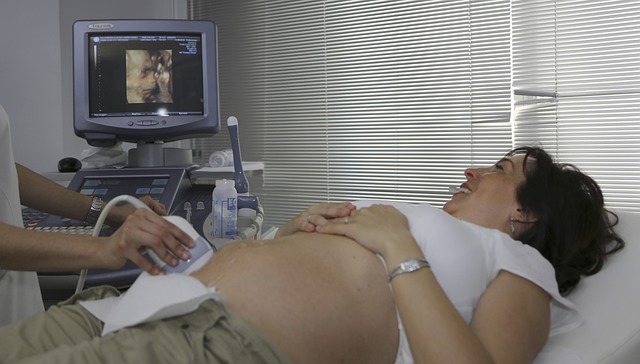
how early can you have a pregnancy scan
 

In the UK, the NHS will typically offer you two pregnancy scans as part of your pregnancy care: one in early pregnancy (between 11 and 14 weeks) and another between 18 and 21 weeks. If you wish to arrange a scan much sooner than this, the earliest you can book a pregnancy scan is from 7 weeks onwards. However, these scans are conducted by private ultrasound clinics rather than the NHS.

pregnancy foods to avoid
If you've recently become pregnant for the first time, you no doubt have a million and one questions to ask about the experience that lies ahead. However, if we had to guess the single most common query amongst mothers-to-be, it would probably be this:
 
Which foods should I avoid while I'm pregnant? 
unborn baby size infographic

If you've had an ultrasound scan with First Encounters before, you may remember seeing the model that we keep in the clinic to show our visitors:
That is a model of a foetus at 20 weeks gestation. We often show it to the expectant parents who come to us for a scan, and almost without exception, they're always surprised to see how small the baby still is at that point. By 20 weeks, the mother's 'baby bump' is usually becoming fairly pronounced, and if you've ever been present during a 3D/4D scan, you'd be forgiven for thinking that babies are rather large indeed by that stage!
 
 
Watching your unborn baby on a big TV screen tends to make them seem larger than they actually are!
 
Many an expectant mother has asked us how big her baby is at X weeks, and so we thought we'd put together a handy guide to baby size  and how it changes from conception to birth. We hope that this will give you a clearer idea of your little darling's current size!
 

How big is my baby at...

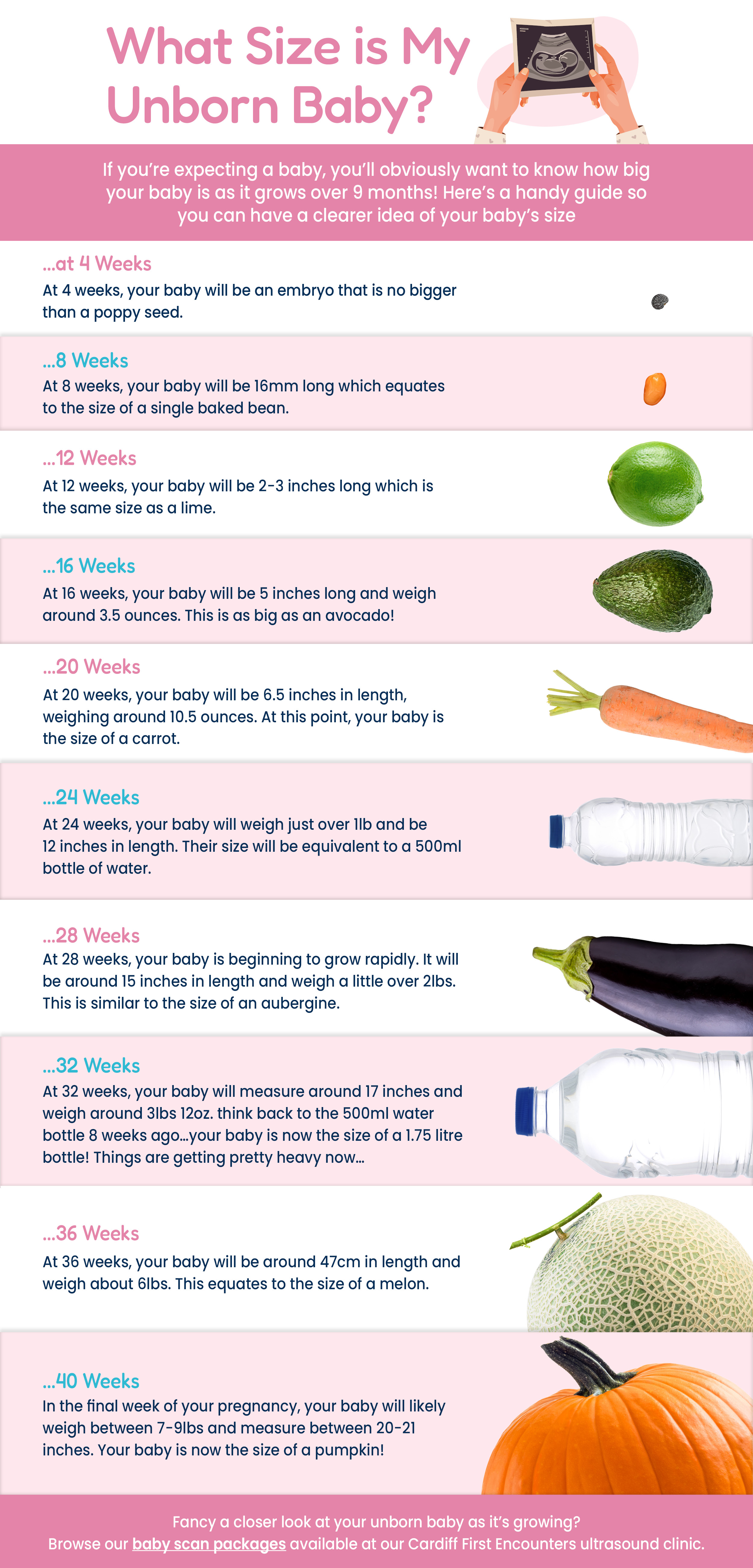
  •  ...4 weeks? Less than a twentieth of an inch long and less than a twentieth of an ounce in weight. At this point, your unborn child is just a tiny embryo, no bigger than a poppy seed. 

  •  ...8 weeks? About 16mm (0.63 inches) long, or roughly the size of a single baked bean. That's more than fifteen times larger than the 4-week-old embryo, although the baby's weight has barely changed since then - we're still talking about a small fraction of an ounce at this stage. 

  •  ...12 weeks? 2-3 inches long and about half an ounce in weight. You're currently carrying a foetus that's more or less the same size as a lime.

  •  ...16 weeks? Just under 5 inches long and about 3.5 ounces in weight. You're now in your second trimester, and the baby is about as big as an avocado.

  • ...20 weeks? 6 and a half inches in length, 10 and half ounces in weight. At this stage, your foetus is a mite shorter than a carrot but weighs quite a bit more.

  • ...24 weeks? Roughly 12 inches in length and somewhat over 1 pound weight-wise. Your unborn baby is growing quite rapidly now, and their current size is roughly similar to that of a 500ml bottle of water.

  • ...28 weeks? By now, your baby should measure about 15 inches and weigh a little more than 2lbs. Picture an aubergine and you won't be too far off.

  • ...32 weeks? Nearly 17 inches, with a weight of around 3lbs 12oz. Remember how, at 24 weeks, your baby was about the size of a 500ml bottle of drink? Well, now he or she is closer to a 1.75 bottle.

  • ...36 weeks? 18.66 inches - that's just over 47cm - in length, and the best part of 6lbs in weight. By now, your baby is roughly the size of a melon.

  • ...40 weeks? Now that you're almost ready to give birth, your baby likely weighs 7-9lbs (although this varies quite a lot) and measures between 20 and 21 inches.
If you'd like to take a closer look at your unborn baby, click here to browse the 3D/4D scan packages available at our Cardiff First Encounters Ultrasound clinic.
Pregnancy Symptoms

If you've recently become pregnant, you're probably wondering what's in store for you over the next 9 months!

To make sure you have all the details you'll need throughout your pregnancy, we've made a week-by-week list of all the most common pregnancy symptoms. Please note that every pregnancy is different, and some people may experience certain symptoms earlier or later than others (if at all), so please don't worry if your own pregnancy doesn't perfectly match the list below.


5 Weeks Pregnant

This is a very common time for women to find out that they are pregnant. This is a very early stage, so don't be surprised if you aren't experiencing any pregnancy symptoms just yet.

However, you may experience:

  • Fatigue - Your body is embarking on a journey that requires a lot of energy, so even at 5 weeks, you may develop a sudden fondness for naps.

  • Frequent Urination - At 5 weeks, your kidneys are beginning to expand, so you might find yourself making more trips to the loo than usual!


7 Weeks Pregnant

You're almost two months in, and it's probably starting to feel a little more real. That being said, it's not unusual to have few (if any) symptoms at 7 weeks - remember, it's still relatively early in your pregnancy.

Some people experience the following symptoms around the 7-week mark:

  • Acne - Your hormones are all over the place right now, so breakouts are completely normal. Just make sure you check with your doctor before using any skin treatments to combat your spots.

  • Cravings - Are you craving foods that you wouldn't normally eat? Or perhaps an old favourite seems strangely unappealing all of a sudden? This is a normal pregnancy symptom, which usually comes paired with morning sickness. Speaking of which...

  • Nausea - The dreaded morning sickness! In spite of its common name, the feeling of nausea can sadly strike at any time of day. You may experience just a touch of nausea, or you may actually vomit - in either case, this is a common side effect of pregnancy at around 7 weeks and probably isn't anything to worry about.


9 Weeks Pregnant

After nine or ten weeks, you'll probably have experienced most of the pregnancy symptoms that tend to strike during the first trimester. In addition to the symptoms listed above, you may now notice:

  • Headaches - Your hormones are still surging, and this can lead to headaches (which can also be brought on by hunger, dehydration and exhaustion - so make sure you're getting plenty of food, water and rest).

  • Nasal Congestion - This is perhaps one of pregnancy's lesser-known side effects. By this stage, you may well notice an increase in your body's mucus production.

  • Breast Tenderness - Your body is prepping for breast feeding and blood flow to this area is increasing, often leading to breast tenderness.


12 Weeks Pregnant

Week twelve is the final week of your first trimester. Your baby has now grown from a tiny cluster of cells into a foetus, and your uterus will be starting to expand beyond your pelvic bones. In addition to all of the symptoms we've already discussed, you may now be experiencing:

  • Dizzy Spells - Those pesky hormones - particularly when coupled with changes in blood pressure - may cause you to feel dizzy. Make sure you sit down or rest during dizzy spells, and always eat/drink regularly to keep your energy up!

  • Pelvic Pain - As your uterus expands, you may experience some aches and pains. It is best to avoid any heavy exercise and be thoughtful about how you position yourself - you don't want to put any unnecessary stress on sensitive regions.


From Here on Out...

As you head into your second trimester, your pregnancy symptoms should become less erratic. Now you can look forward to your bump getting bigger and the baby starting to kick. You will probably continue to experience some aches and pains, and you should continue to go for regular check-ups to make sure that you and your baby-to-be are both healthy.

Here are a few milestone moments to look out for later in your pregnancy journey:

  • 13-15 Weeks Pregnant: This is generally the point at which you'll need to purchase maternity clothes. Of course, you may want to buy it earlier just for the comfort it provides!

  • 20-25 Weeks Pregnant: It's around this time that you'll start to feel your baby kicking. Again, every pregnancy is different, so don't worry too much if you have to wait a bit longer.

  • Approaching Due Date: Few women actually give birth on their exact due date. Nonetheless, it's an important date, and its passing signifies that your new baby will be with you very soon!


If you're 7-14 weeks pregnant, why not book an EarlyReassure™ scan with First Encounters? We also offer a 4DGrowth&Wellbeing™ scan for when you're a little further along and you're ready to see what your little one looks like!

Image from pixabay.com

Have you ever found yourself wondering what an ectopic pregnancy is, what causes one, or what signs indicate an ectopic pregnancy? We have put together an informal guide on spotting the signs of an ectopic pregnancy, which also explains the condition in greater detail, and outlines its possible impact on future fertility.
 
What is an Ectopic Pregnancy?
 
An ectopic pregnancy occurs when a fertilised egg implants itself outside of the womb, usually inside one of the fallopian tubes, which connect the ovaries to the womb. Often it causes pain and bleeding, which may develop into a Fallopian tube rupture with internal bleeding, should the pregnancy be left untreated.
 
This presents significant health risks to the individual as the pregnancy develops, which means that it has to be removed, either using medication or by performing an operation in more serious cases. Sadly, the pregnancy cannot be saved due to the serious nature of the condition, which can be fatal if left untreated.
 
 
What is the Cause?
 
While the cause of an ectopic pregnancy isn't always clear, it is sometimes due to an issue with the Fallopian tubes, in the case that they are too narrow or have become blocked. An egg will usually spend around five days travelling down the tube and into your womb, where it should implant and develop if fertilised. In the case of an ectopic pregnancy, the egg hasn't travelled far enough when it implants, leading to it developing in the tube itself.
 
While there are certain factors which increase the risk of an ectopic pregnancy, one in three women who suffer the abnormality will have none of the known risk factors. It is important to know what these risk factors are as it may aid in identifying the condition if you are aware of your own personal risk level.
 
You could be at greater risk if:
  • You've suffered from pelvic inflammatory disease (often caused by chlamydia)
  • You've had abdominal surgery, such as appendix removal or a c-section
  • You've become pregnant using IVF
  • You've become pregnant whilst using an IUD or taking the contraceptive mini-pill.
  • You've suffered a previous ectopic pregnancy 
 
 
How Common is the Condition?
 
An ectopic pregnancy happens in around one in every ninety pregnancies in the UK, however, this risk increases to one in ten for the individual who has suffered an ectopic pregnancy before.  In 98% of cases, it will implant in the Fallopian tubes, but in some cases, the egg can implant in the abdomen, ovary, cervix or within a c-section scar.
 
 
What are the Signs of an Ectopic Pregnancy?
 
Identifying an ectopic pregnancy isn't always straightforward because the symptoms can sometimes mirror those of a period or miscarriage, causing cramping and bleeding. The symptoms may also develop gradually, or come upon the individual suddenly, with the early stages sometimes developing without any symptoms at all.
 
Some symptoms include:
  • Expected signs of pregnancy
  • Vaginal bleeding that is different from your usual period, which can sometimes be lighter and brighter in colour, or darker than usual
  • Pain in your lower abdomen/pelvis, which can be gradual or sudden, and may be on one side.
 
Signs of a severe case which has caused a rupture include:
  • Lightheaded/faint feelings
  • Diarrhoea or pain when passing water/stools 
  • Shock or collapse due to internal bleeding
  • Shoulder tip pain, which may be made worse by lying down
 
How Does Suffering an Ectopic Pregnancy Impact Future Fertility?
 
The chances of having a healthy pregnancy after suffering an ectopic pregnancy will depend on the individual, as it relates to the health of your fallopian tubes, and that of the remaining tube if you have had to have one removed. If it has been caused by a previous pelvic infection, this may have a further impact on your fertility.
 
One healthy tube means that you have a good chance of conceiving again, and six out of ten women manage to do so effectively, going on to have a healthy pregnancy. For those who struggle to conceive, IVF may be an option.
 
If you would like to try to become pregnant after suffering an ectopic pregnancy, you should first ensure that you have properly healed from the physical and emotional damage. As always, you should consult your doctor in order to gain the best advice for your personal case.
 
In the case of keyhole surgery, you should wait until you've had at least two full menstrual cycles before trying for a baby, and six months in the case of abdominal surgery. If you've taken methotrexate, you should wait at least three months before trying to conceive, to ensure that it is out of your system completely.
 
If you suspect that you may be suffering an ectopic pregnancy, see your doctor at once, or go to the hospital directly if you feel that your symptoms are becoming worse.
 
The EarlyReassure™ scan package from First Encounters Ultrasound is an early pregnancy scan that can identify ectopic pregnancies and other potential issues early on. Click here to book your EarlyReassure™ scan.